
Socialising Your Puppy
Why it needs to Be Taught Not Just Experienced
“Don’t worry, they need to socialise.”
It’s something I hear all the time when I’m out walking my own dogs.
A puppy is charging around a public park, running up to every dog they can find, and the owner is watching happily as their puppy launches themselves into yet another interaction.
They’re socialising, after all.
Except… they’re not. Or at least, not in the way most people think.
One of the biggest misunderstandings I see with new puppy owners is that socialisation means meeting lots of other dogs and people.
It doesn’t.
In fact, meeting other dogs should probably be much less important than most people think.
Good socialisation is about helping your puppy learn how to navigate the world around them. It’s about experiencing new things, learning to make good decisions, building confidence and discovering that their human is there to guide them when something feels unfamiliar.
And that is something we need to actively teach.
So, what actually is socialising your puppy?
Socialisation isn’t a checklist of people, dogs and places your puppy needs to tick off before they’re 16 weeks old.
It’s a process of helping your puppy develop the skills they need to cope with life.
That might mean:
- hearing a strange noise without panicking
- walking over different surfaces
- watching bicycles go past
- experiencing traffic
- meeting people who look, sound and move differently
- calmly observing other dogs without needing to greet them
- learning that a stranger doesn’t automatically mean hands on their body
- investigating something unfamiliar
- learning that they can move away when they need space
- experiencing something new and recovering quickly afterwards
- learning that when something is worrying or confusing, their human will help
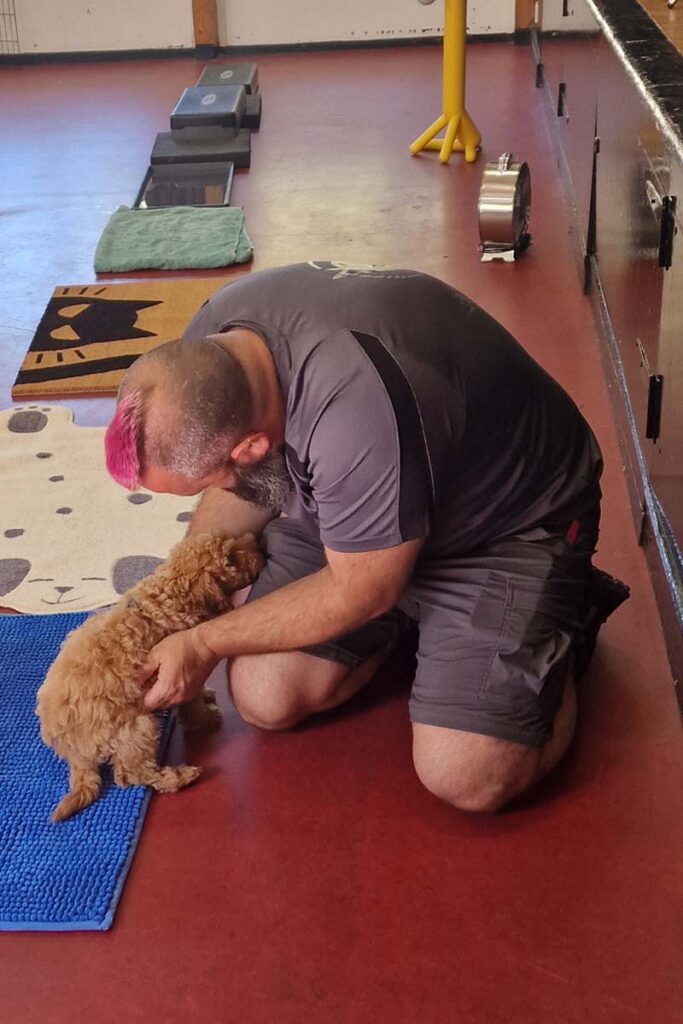
There is a huge amount of learning happening during these experiences.
And the most important question isn’t:
“Has my puppy experienced this?”
It’s:
“How did my puppy experience it?”
That distinction matters.
More isn't necessarily better
It’s very easy to fall into the trap of thinking that if a little socialisation is good, lots must be better.
So we take our puppy everywhere.
We visit busy parks.
We let them meet everyone.
We encourage them to play with every dog.
We take them out for hours because they’re having such a wonderful time.
And then we wonder why our puppy becomes increasingly excitable, struggles to settle, starts barking at other dogs or becomes frantic whenever they see someone approaching.
Sometimes what looks like a puppy having the time of their life is actually a puppy who is massively over-aroused and doesn’t yet have the skills to regulate themselves.
Young puppies aren’t equipped to deal with endless excitement simply because they’re young and enthusiastic.
And a tired puppy isn’t necessarily a happy puppy.
Sometimes they’re just exhausted.
The quality of an experience matters far more than how many experiences we can cram into a puppy’s day.
I often think about it in very simple terms:
Good socialisation = novelty + choice + appropriate challenge + recovery + safety.
Not:
More people + more dogs + more places = better socialisation.
Lorem ipsum dolor sit amet, consectetur adipiscing elit. Ut elit tellus, luctus nec ullamcorper mattis, pulvinar dapibus leo.
Your puppy is constantly communicating with you
One of the most valuable things you can learn as a puppy owner is how to recognise the very subtle ways your puppy tells you:
“I’m not sure about this.”
The problem is that puppies don’t always make their discomfort obvious.
They don’t necessarily growl.
They don’t necessarily bark.
They don’t necessarily try to run away.
They might make themselves smaller.
They might turn their head away.
They might lick their lips.
They might show their belly.
They might freeze.
They might suddenly become very still.
They might stop exploring.
They might look at you.
They might try to move behind you.

And these behaviours are very easy to misunderstand.
A puppy showing their belly isn’t automatically asking for a belly rub.
A puppy licking someone’s face isn’t necessarily saying, “I love you.”
A puppy sitting completely still in the middle of a busy environment isn’t necessarily being wonderfully calm.
One of the most valuable things you can learn as a puppy owner is how to recognise the very subtle ways your puppy tells you:
“I’m not sure about this.”
The problem is that puppies don’t always make their discomfort obvious.
Sometimes these behaviours are communication.
They’re a puppy politely asking for a little more space.
And if those quieter attempts to communicate are repeatedly ignored, eventually the puppy may find a louder way to say it.
A growl.
A snap.
A bite.
Or, sometimes, simply shutting down.
None of these things necessarily mean you’ve suddenly got a “bad” puppy.
They may mean you’ve missed a lot of much quieter conversations that happened beforehand.
This is why socialising your puppy needs to involve the human too
Your puppy isn’t the only one who needs to learn.
You do too.
You need to learn what your puppy looks like when they’re confident.
What they look like when they’re unsure.
What makes them excited.
What makes them worried.
When they’re coping.
When they’re getting overwhelmed.
When they need help

And, perhaps most importantly, when you need to step in and advocate for them.
One of the biggest lessons I want puppy owners to take away is that your puppy doesn’t need to say hello to everything.
They don’t need to greet every dog.
They don’t need to be touched by every stranger.
They don’t need to play with every puppy.
And they certainly don’t need to spend their entire walk interacting with other dogs.
Sometimes the best socialisation experience is simply watching something interesting from a comfortable distance and then moving on.
Your puppy learns:
I can look at that.
I don’t have to go towards it.
My human understands.
I am safe.
That is an incredibly useful lesson.

What I learned about socialising your puppy from my own dogs
I didn’t get everything right with my own dogs.
And I think that’s important to say.
Magik (Dutch Shepherd) was dog-obsessed from the day we got her.
Five years of living with her has taught me an enormous amount about who she is, what she needs and how she experiences the world.
She has a very strong social need.
But I’ve often wondered whether some of that was simply who she was genetically, or whether we accidentally helped create some of it during those crucial early months.
We’ll probably never know.
If I could go back, I would be much more selective about the dogs she met.
I would have deliberately sought out calm, socially savvy adult dogs who could give her good experiences and teach her something about appropriate interaction.
Instead, we often avoided those situations because she was simply a lot.
Everything was a little bit too much with Magik.
We were doing our best. We were learning. And, like most new dog owners, we made plenty of beginner mistakes.
Leia has been a completely different experience.
From a young age she was incredibly socially savvy. She naturally adjusted herself to the environment around her and generally took new things in her stride.
Part of that is who she is.
Part of it is what we knew by then.
And that contrast has taught me something important:
There isn’t one socialisation recipe that works for every puppy.
You have to learn the puppy standing in front of you.
And this is where socialising your puppy at puppy parties can go wrong
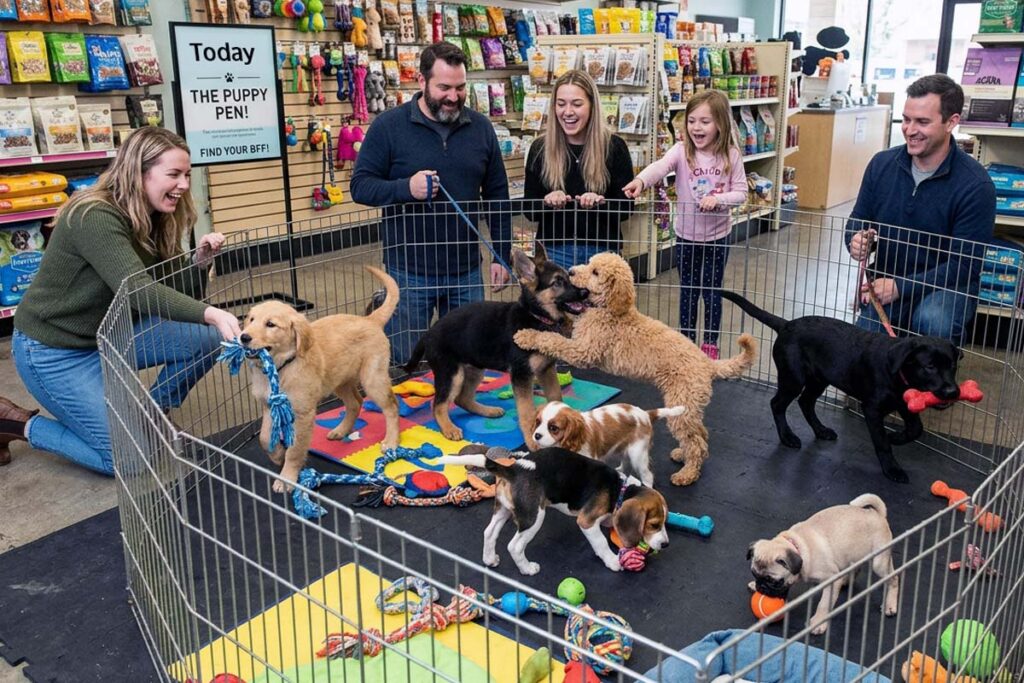
Puppy parties sound like the perfect socialisation opportunity.
Put a room full of puppies together and let them play.
What could be better?
The problem is that puppy play and socialising your puppy aren’t the same thing.
A puppy party can involve several puppies interacting at once, often with very different sizes, confidence levels, play styles and communication skills.
That’s a lot for young dogs to navigate.
A shy puppy can quickly become overwhelmed by a confident, bouncy puppy.
A confident puppy can discover that repeatedly chasing, body-slamming or pestering another dog is enormous fun — and accidentally learn that this is how interactions work.
And when several puppies are interacting at once, it becomes much harder to create a fair, balanced experience for everyone.
There is also a common idea that puppies need to “learn boundaries from other puppies”.
There is some truth in the fact that dogs learn from one another.
But we’ve domesticated dogs to live alongside us too.
We have a responsibility to teach them.
We shouldn’t simply throw a group of highly aroused young dogs together and hope they’ll figure it out.
Young puppies don’t necessarily have the emotional regulation or social skills to manage that situation themselves.
And when arousal levels climb, learning doesn’t suddenly get better.
It can become a recipe for unpleasant experiences that nobody intended.
That doesn’t mean puppies should never play.
Quite the opposite.
Good puppy play can be fantastic.
But it should be carefully managed, appropriately matched and supervised, with plenty of opportunities for puppies to pause, disengage and make choices.
A puppy party asks a different question
This is probably the simplest way I can explain the difference.
A puppy party asks:
“How can we get these puppies to interact?”
A good socialisation session asks:
“What does each puppy need to learn from this experience?”
That changes everything.
Instead of putting every puppy into the same situation, we can consider the individual dog in front of us.
Maybe that puppy needs to watch from a distance.
Maybe they need a calm interaction with one carefully selected dog.
Maybe they need to practise moving away from another puppy.
Maybe they need to experience a new surface.
Maybe they need to learn that being handled is something they have a choice about.
Maybe their human needs to learn when to step in.
And sometimes the most valuable thing a puppy can learn is that they don’t have to interact at all.
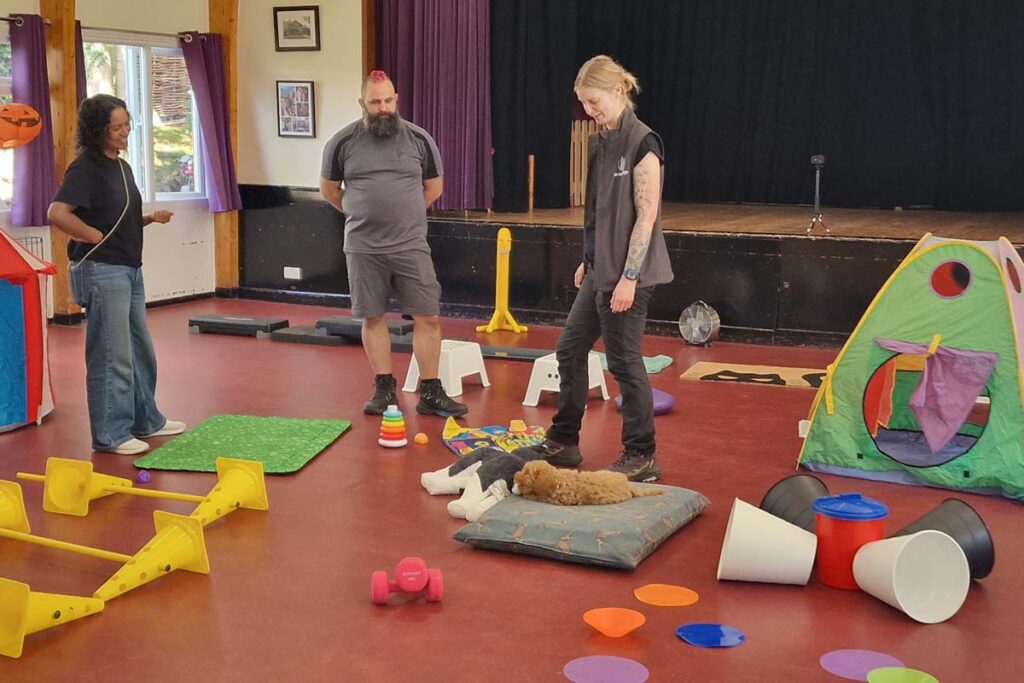
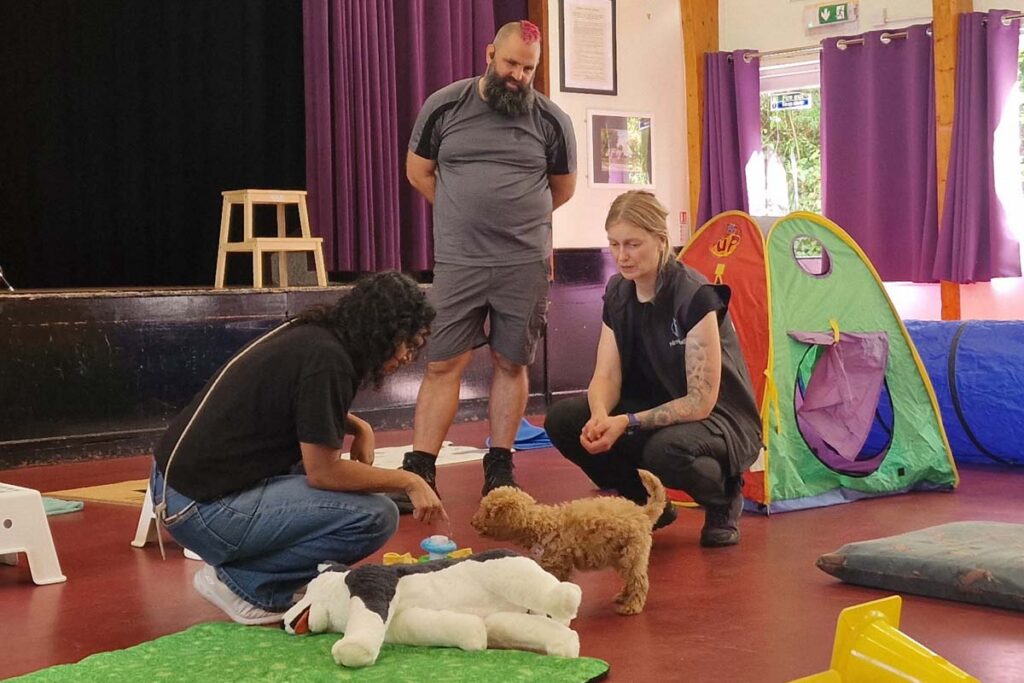
What controlled socialising your puppy actually looks like
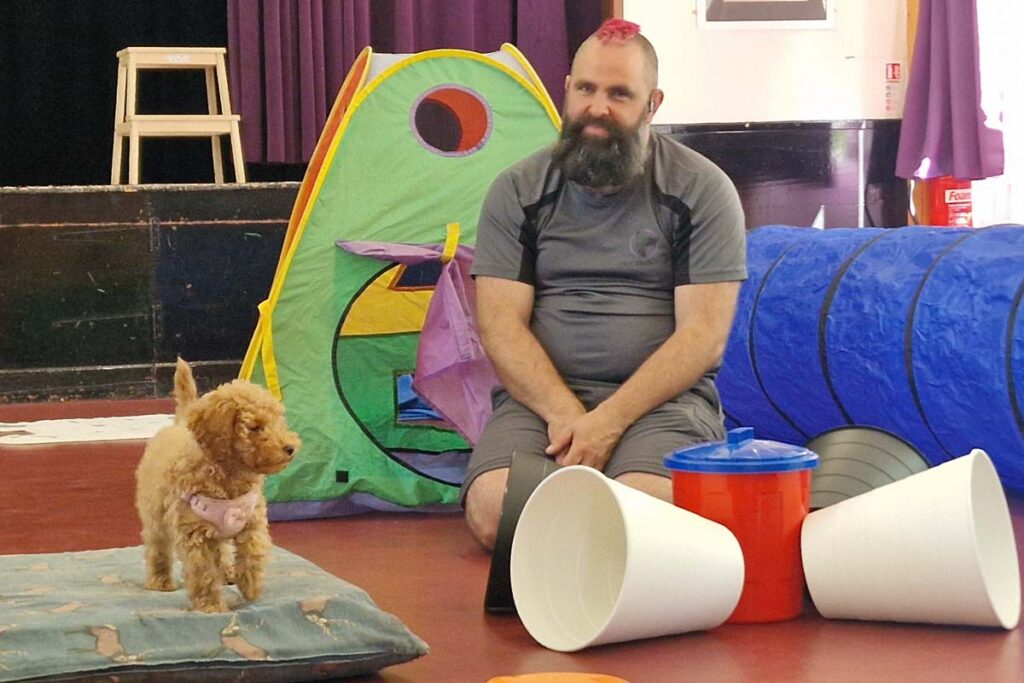
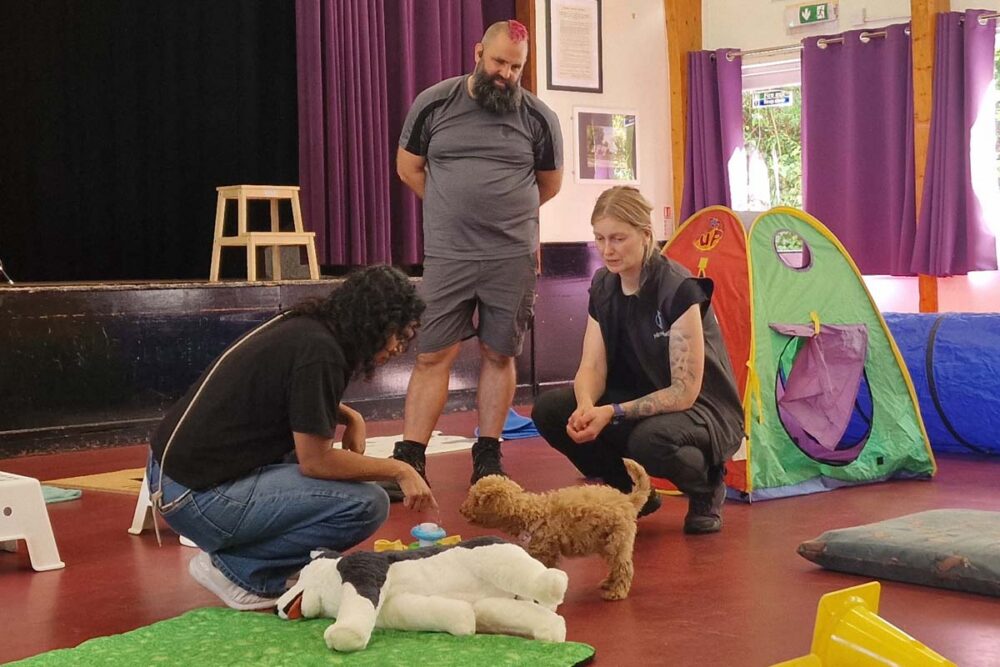
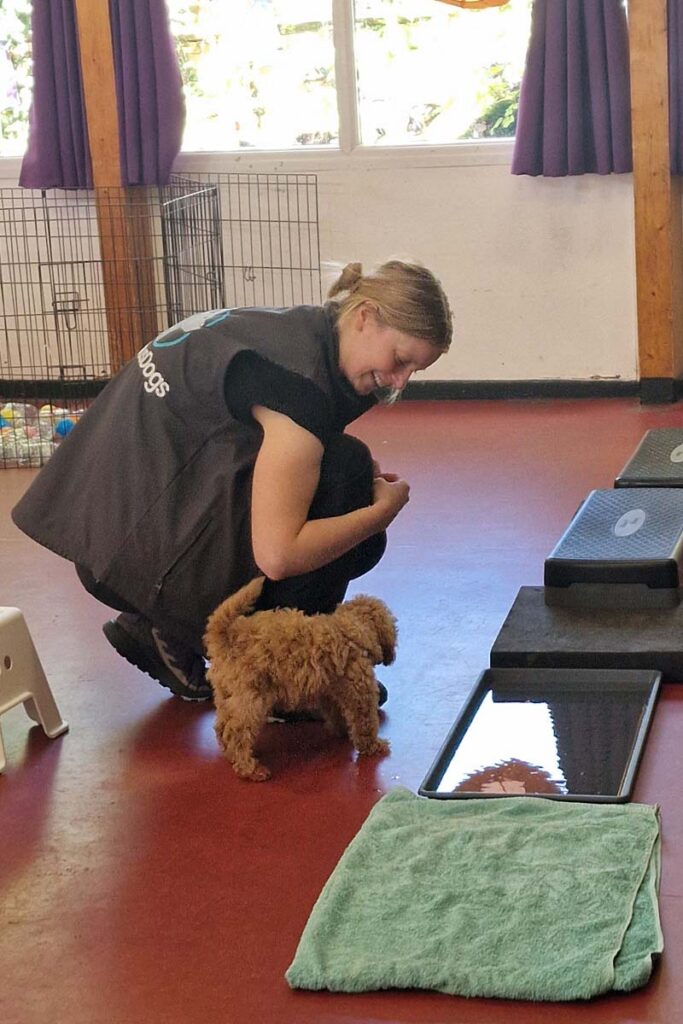
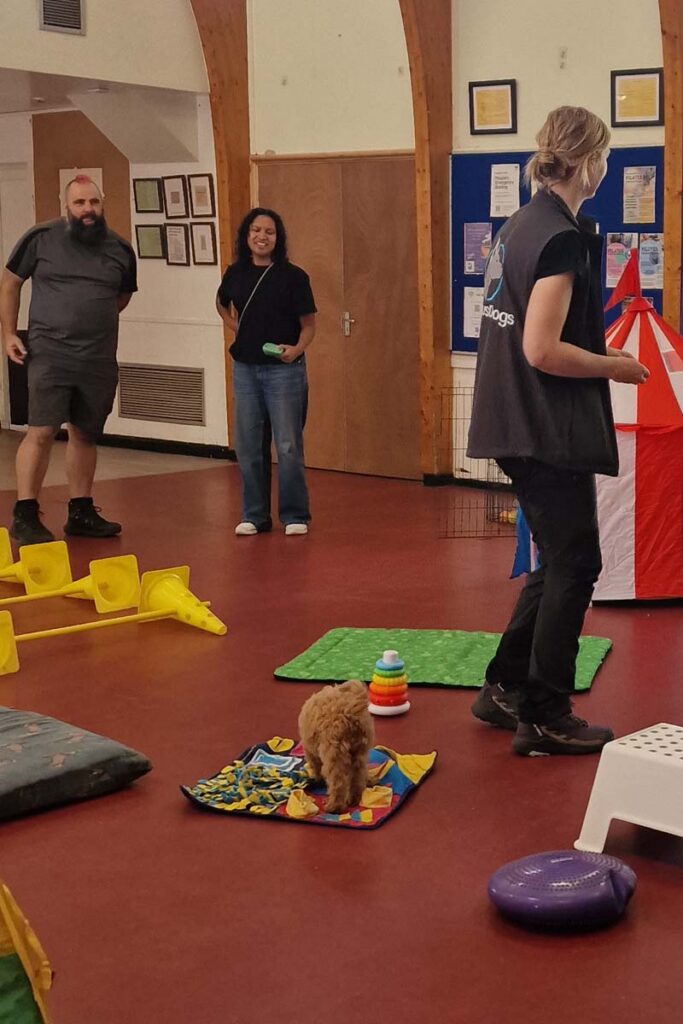
A controlled environment isn’t about preventing puppies from having fun.
It’s about creating experiences they can actually learn from.
Keeping groups small means there is more time to observe each puppy properly.
It means puppies can be paired with appropriate playmates.
It means a quieter puppy doesn’t have to be overwhelmed by a much bigger, bouncier dog.
It means a confident puppy doesn’t get to practise bullying behaviour until it becomes a habit.
It means we can give owners individual guidance rather than simply watching a room full of puppies play.
And it means we can teach the human as much as we teach the puppy.
Because ultimately, your puppy is going to encounter the real world with you.
Not with their puppy class.
Not with their trainer.
Not with a room full of carefully selected puppies.
With you.
So you need to know what to look for.
You need to know when to move closer.
When to give more space.
When to let your puppy investigate.
When to intervene.
When to leave.
And when your puppy is telling you, very politely, that they’ve had enough.
Socialising your puppy is about learning that the world is a safe place to explore
A confident puppy isn’t necessarily a fearless puppy.
In fact, I’d argue that confidence has very little to do with never being worried.
A confident puppy can encounter something unfamiliar, make a decision about it, investigate if they want to and recover quickly if something doesn’t go to plan.
And not every puppy starts from the same place.
Some are naturally bold.
Some are cautious.
Some are incredibly social.
Some would rather watch from the sidelines.
But even a less confident puppy can grow in confidence when we give them the right guidance.
We can give them enough support to trust us.
Enough choice to make decisions.
Enough space to process what is happening.
And enough positive experiences to make them want to explore a little further next time.
That is what I want from socialisation.
Not a puppy who thinks every person and every dog is their new best friend.
A puppy who thinks:
“I can handle this. My human has got me. Let’s go and see what’s over there.”
Socialising Your Puppy doesn't end at 16 weeks
One final misconception is worth addressing.
Socialisation isn’t something you complete.
There isn’t a magic number of dogs your puppy needs to meet.
There isn’t a list you can tick off.
And there isn’t a birthday when socialisation suddenly stops.
Your puppy will continue encountering new experiences throughout adolescence and adulthood.
New environments.
New people.
New noises.
New surfaces.
New situations.
New challenges.
The more we learn to introduce those experiences at a level our dogs can actually handle, the more opportunities we give them to build confidence and resilience.
That’s why learning how to socialise your puppy is so much more valuable than simply trying to socialise them as much as possible.
So, what should you actually do?
Start watching your puppy.
Really watching them.
Don’t just ask:
“Is my puppy having fun?”
Ask:
- Are they comfortable?
- Are they choosing to interact?
- Can they disengage?
- Can they recover?
- Are they able to make decisions?
- Are they becoming more confident or more overwhelmed?
- Am I helping them when they need me?
- What are they trying to tell me?
And remember:
Your puppy doesn’t need to meet more dogs. They need to learn how to navigate the world.
That’s a very different job.
And it’s one we can help them with.
Want to learn how to socialise your puppy properly?
If you’ve got a puppy under six months old, I run monthly Puppy Socialisation Sessions at Nimbus Dogs for exactly this reason.
These aren’t puppy parties.
We’re not going to throw a room full of puppies together and hope they work it out.
Instead, you’ll spend time learning how to read your individual puppy, understand what they’re communicating and recognise what they need from you.
We’ll look at how to introduce your puppy to the world thoughtfully, how to create positive experiences, when to step in, when to give them space and how to become the kind of guardian your puppy can rely on.
You’ll get the opportunity to learn alongside your puppy, have some fun together and leave with practical knowledge you can use every day.
Because the best socialisation isn’t about creating a puppy who loves everything.
It’s about raising a dog who feels confident exploring the world because they know you are there to help them navigate it.